Silence Kills
Our lives begin to end the day we become silent about things that matter.” – Martin Luther King, Jr.
 This is the quote that inspired the title for my book, The Weight of Silence. To stay silent, to say nothing in the face of injustice or suffering, to turn the other way, is to be complicit in them.
To close out 2014, I would like to share the words of a far more powerful writer than myself: Elie Wiesel. His words show even more, the weight of silence. The words are from his Nobel Peace Prize acceptance speech, awarded for his intense, life-altering book Night. This speech was given in Oslo, Norway on December 10, 1986. While his book may have been about the Holocaust, the words resonate just as much in today’s world.
And if you haven’t read Night, make that your first New Year’s Resolution.
“I swore never to be silent whenever and wherever human beings endure suffering and humiliation. We must take sides. Neutrality helps the oppressor, never the victim. Silence encourages the tormentor, never the tormented. Sometimes we must interfere. When human lives are endangered, when human dignity is in jeopardy, national borders and sensitivities become irrelevant. Wherever men and women are persecuted because of their race, religion, or political views, that place must — at that moment — become the center of the universe.
There is so much to be done; there is so much that can be done. One person — a Raoul Wallenberg, an Albert Schweitzer, a Martin Luther King Jr. — one person of integrity can make a difference, a difference of life and death. As long as one dissident is in prison, our freedom will not be true.
As long as one child is hungry, our life will be filled with anguish and shame.
What all these victims need above all is to know that they are not alone; that we are not forgetting them, that when their voices are stifled we shall lend them ours; that while their freedom depends on ours, the quality of our freedom depends on theirs.
Our lives no longer belong to us alone; they belong to all those who need us desperately.”

Elie Wiesel accepting his Nobel Peace Prize. Click the photo to watch a video of his full speech at the Nobel Prize website.
Miracles in the Making
They love with their entire beings. They have so little, yet give everything they have. They ask nothing else from us other than to be there. I cannot say that for very many people in this world.
Here at the holidays, miracles are often spoken of. With all the suffering and pain and hate in the world today, it’s even more important to find the miracles, and to share them. I have witnessed many miracles first-hand in India: Children who were once lost, found. Lives that could have been shattered, blooming new hope and meaning. In places where there might be grief and sorrow, finding smiles and joy and generosity.
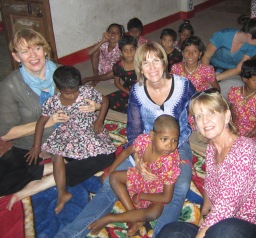
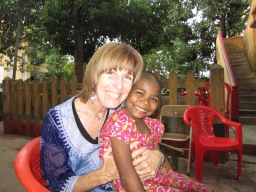
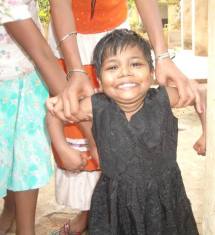 One such miracle can be found in a small girl named Aiswarya. I first met Aiswarya in 2010, on one of my visits to my “other home” in Choudwar, India. After a day or two of seeing all the kids I love so much, exclaiming over how they had grown in the past year I’d been away, playing and laughing and being together — Jody and I went into the baby room.
There are usually several babies here, two or three or four, ranging in age from a few months to a year or so. Most of the time they are adopted, so we rarely see them again on the next visit. After the housemother showed me and Jody the infants who were currently in their care, we noticed a larger girl huddled on a bed in the corner.
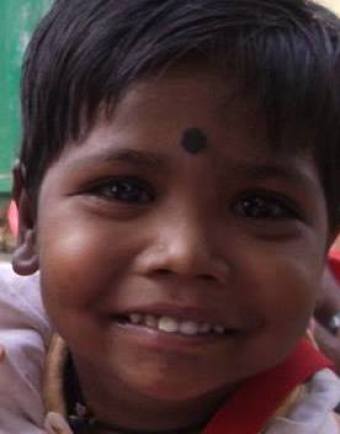
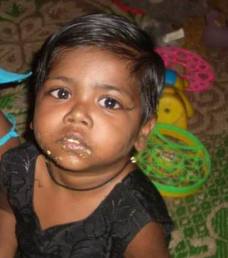 She was Aiswarya; Jody had met her on a previous trip. “Aiswarya was absolutely terrified of us and couldn’t even crawl at that time,” Jody says. Now, in 2010, she was nearly 5 years old, which stunned me. I could tell she was much older than the babies around her, but I would have guessed she was maybe two. Jody reached out a finger and touched Aiswarya’s shoulder. The tiny girl turned her head and looked up at us with the hugest, deepest, bottomless eyes I’ve ever seen. They were at once young and old, innocent and wise, tired and hopeful. I have never seen such eyes.
It was clear that the girl rarely left this room, or in fact this bed. We talked to Papa more about Aiswarya and her condition; we were told she had something wrong with her — which was obvious. She could not walk, therefore she laid there in that bed more than 20 hours a day. Papa brought out her medical records.
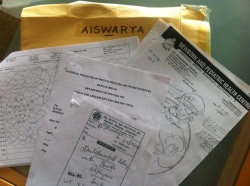 There had been a developmental delay at her birth; the chart said “asphyxia.” There were doctor’s notes and printouts of brain scans. Other notations from the hospital visits he had taken her on, in Cuttack and Bhubaneswar and Bangalore, said “Unable to walk without support.” “Seizure disorder.” “Dull, poor standing balance.” And most heartbreaking: “Early details not available.”
It was hard to bear the thought of this precious girl, with that strong gleam of life in her eyes, wasting away in that bed, in that dark room. Papa had done what he could, but there were limited resources; very little help.
We took her records with us to the Miracle Foundation orphanage we were visiting next, where — as fate would have it — the volunteer trip there was a medical trip. We had the doctors there look at Aiswarya’s records and give their recommendations for treatment, which we sent back to Papa along with donations and pledges of support for Aiswarya’s medical care.
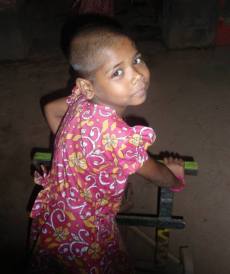
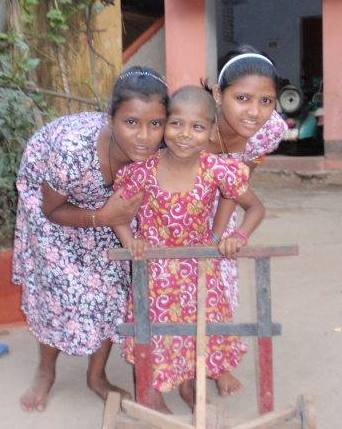 In 2012, we returned to the Choudwar home with our new group of volunteers. As we walked into the courtyard, greeting and kissing and hugging the children again, we noticed a girl making her way from the sidewalk, walking behind a handmade wooden walker.
It was Aiswarya.
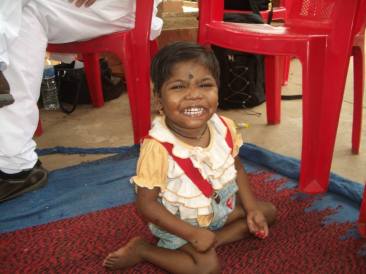
The largest grin imaginable split her face in two. A light that cut right into your heart emanated from those eyes, in joy and delight. She was walking! Assisted, and with a little pieced-together walker, but she was on her own two feet, out in the sunlight with the other children. We were speechless.
On this last trip, two years later, Aiswarya’s miracle continued. This time, she came walking out to greet us on her own two legs. Unassisted. She walks on the sides of her feet and has a distinct limp, and occasionally she falls down. But the other kids help her up, and she runs and plays just like any of them.
Aiswarya truly is a miracle. It is these moments, these astounding strides (literally and figuratively) that keep us going back. That keep us connected, with a thread far stronger than blood, to this family across the world.
And Aiswarya’s eyes are still the most intense things. She will hold your gaze, stare straight into your soul until it feels you can see all of infinity. Those dark, shining pools of brown that you feel you can get lost in. And, just when you are about to drown, her grin takes over and she lets out a laugh of pure joy.
All you can do is laugh with her.
The Story of Santosh

My first trip to India, 2005, with Santosh and Daina
Many of you who have followed my trips to India throughout the years and/or read my book, know about Santosh. The first child I sponsored at the orphanage, who I first met on my initial trip there in March 2005. Then 11-years-old, I thought Santosh was too shy of my attention, and that I would have little interaction with him during the week. That first night, when Papa Sahoo (who runs the home) called him out to meet his sponsor, he was very wooden and shy, and quickly ran off.
But moments later he was back, with a Texas cap that my friend and co-sponsor Craig had sent him. Throughout that first trip Santosh was often at my side, to my surprise. In the several years and trips back to the children’s home after that, I realized the impact it makes to these children to be sought out – to be remembered, to be made to feel special and loved. Not in general, but specifically – because they are the individual child they are. Just like our own children or loved ones. To know that they are somebody to someone. That they matter.
Then, after a few years, suddenly Santosh was gone from the orphanage. When he was about 15, his father removed him from the home and sent him to live (and work) with a guardian a couple of hours south in Konark. I am guessing at the time, that Santosh figured I was history. He would never see me again.
But he didn’t realize just how stubborn I was. Or just how special he was.
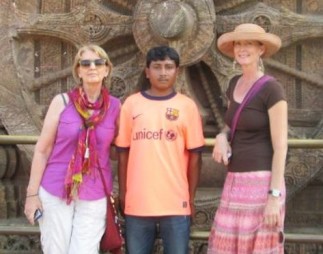
With my mom and Santosh in Konark, 2012
I bugged Papa for details of where Santosh was, exactly. Craig, his co-sponsor, went to find him in Konark that first time. On my next trip to India, I also went to Konark and found Santosh. Fortunately his guardian, Pravat, is a good and caring man who took Santosh into his home and family. That was five years ago, and since that time I have visited Santosh just as I do the home in Choudwar where he once lived – and where 115 other orphans still live. In fact, all these years since Santosh left the home, I have also brought him up to Choudwar to visit his friends there again and to spend time with me and my family/ volunteer group while we are there. On the trips to India he would smile and laugh with us, join us at dinner and even staying in our hotel with us, holding my hand as we walked the streets of India – Santosh always on the street side to protect me from danger.
In the last few years, the beauty of technology made our communication even easier: Santosh was on email, and Facebook, and Skype! The world between Texas and India shrunk just a little bit, and Santosh and I were still in each other’s lives.
No, Santosh, you were never forgotten.
But then, early this year in 2014, something happened. Exactly what I am still not sure of, but Santosh had some sort of problem. He was attacked and robbed, I believe, and he lost both money and his mobile phone which was his link to communications and the online world. Suddenly, I stopped hearing from him. He didn’t return my messages; his mobile number was disconnected; he disappeared from Facebook and Skype.
I worried, as any mother would.
I sent messages to his guardian, Pravat, and his friends Kshetra and Mithun who are also in Facebook. They gave me small pieces of information but still, no direct word from Santosh. I was anxious to get back to India in person this fall, to see Santosh in person and re-establish contact. To find out what was going on. To let him know that Mom still cared what happened to him.
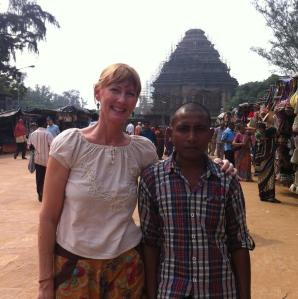
Finding Santosh, 2014
Two days after I landed in India, I was in a car going to Konark where Santosh lives and works. After not having spoken to him or heard from him in months. I pulled up to the market where he works in the family store, and Pravat brought him out to meet me. Santosh was wooden, as he was on the first night I had met him nearly a decade before as a child. He wouldn’t meet my eyes or return my hug. I explained to both of them, with Pravat translating some of what Santosh’s limited English might not grasp.
“Santosh, I have been so worried about you. All these months I have thought of you every day and hoped you were all right. I wanted to hear from you. I came here to see you, the very first thing. Before I went to the home in Choudwar or saw Papa and the other kids. Coming here to see you, to make sure you are all right, was the first thing I did when I got to India. I am your mom, and I love you always.”
Suddenly, Santosh started crying. The boy who is now a young man, a sometimes moody adolescent who was often stoic and rarely showed a lot of emotion. Tears were now streaming down his face and he wiped them away roughly with the back of his hand.
Pravat said, “He thought you had forgotten him.”
My heart felt such a stab. This boy who had lost his mother before he even knew her; whose father took him to the orphanage by the time he was two years old. To lose another parent figure, what must that feel like?
I assured Santosh that I had NEVER forgotten him. Not for one day, one moment. And that I never would.
Finally, a smile. Smiles and hand holding and laughter all day. I went with Pravat and Santosh to their home, where I spent the day with their family and ate lunch with them.
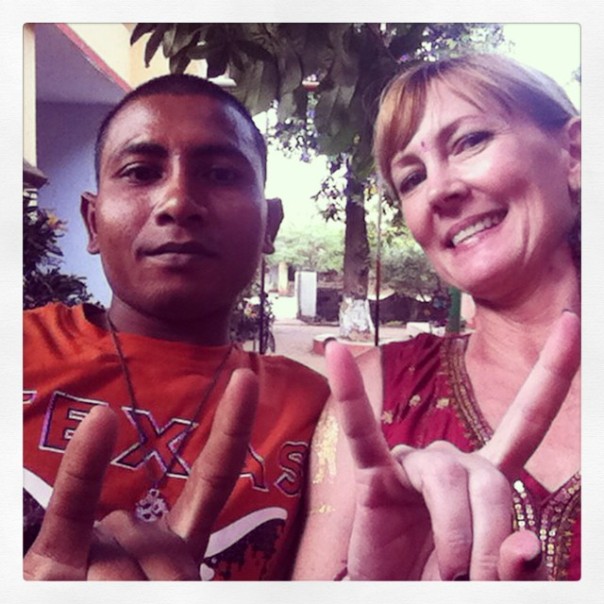
A few days later, after the rest of our volunteer group arrived in Choudwar to spend our week at the orphanage with the kids, Santosh came up on the bus and we picked him up. He spent the next several days with our volunteer group, staying at the hotel with us and going to the children’s home with us and generally having a great time. There was a lot of smiling and love, even dancing and singing.
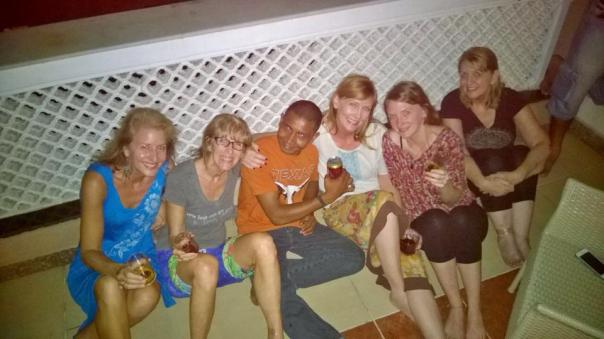
Hanging out with friends and family at our hotel after a day at the children’s home
Santosh was back. For anyone who ever wonders why we do this – why we go back, over and over and over – this is why. All you ever need to know to answer that question is in this story.
And I believe, now, Santosh knows for certain, that he will never be forgotten. That he is part of our family, and always will be. Not because he was an orphan, or a kid at the home that I sponsored. Not because I feel obligated, or sorry for him, or have to. But because he is HIM, Santosh, and I – we all – love him for the special, unique person that he is.
Family.
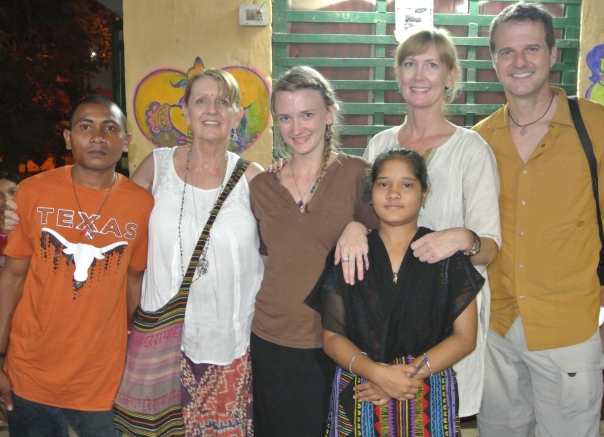
Our blended family. Because it’s not blood, or even continents, that matter.
Return to India
It was planned all year, and now I can’t believe it’s over.
I just returned from my 8th trip to visit my family in India. I have been planning this trip since January of this year. Now that I’m back home, it’s hard to believe the time — so long anticipated — has come and gone. That it’s over.
Already I miss the kids so much, all those whom I love and who have made their home my home, their family my family, over the past 10 years.
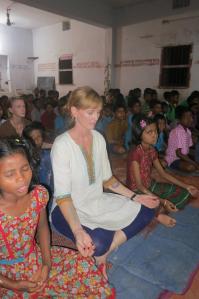 The first night I was ever in India, nearly 10 years ago, was spent in this room. The prayer room in the ashram in Choudwar, Odisha, moments after arriving. It turned my world, my idea of existence and who I am in this life, upside down. This is what I wrote in my book about my first night in prayer time with the kids:
“It was a simple prayer, reminding me that life need not be complicated unless we made it so. A soothing peace palpable in the air filled me. I breathed out deeply. There seemed no other world outside this place.
I wondered when each of them had stopped wanting to go home, or if they ever had. Home is a fragile concept — far more delicate than those of us who have always had one can imagine. When a person no longer has a home, when his family is taken from him and he is deprived of everything that was familiar, then after a while wherever he is becomes home.
Slowly, the pieces of memory fade, until this strange new place is not strange anymore; it becomes harder to recall the past life, a long ago family, until one day he realizes he is home.”
Sitting with my eyes closed, chanting, “Ohm, ohm…shanti, shanti, shanti” and listening to a hundred sweet voices sing around me — I feel my true self the most. There is nothing better on earth for setting the soul right. Even after all the many nights I’ve spent here over the years since, this is my all-time happy place. I know that I am home, too.
Below is a video of prayer on our very last night. Bittersweet…leaving is always so hard.
Even though I’m sad the trip is over and I’m having my typical India withdrawal, the visit was amazing. As always, being home and being with the children (as well as my Papa and Mama!) is such a homecoming, such a treat that seems to make everything right with the world. It was also an incredible visit because of the group we had. Joining me as she has on nearly every trip was my dear friend Jody, also a long-time supporter of the orphanage over the years. I was honored to be able to take both my mother and my daughter back for their second trips — my mom Sandy went last time, in 2012; and my daughter Chandler returned for the first time since 2006, when she was only 15 years old!
Also returning with us were my boyfriend, Keith; Kathleen, who was with me on that very first trip and was making her first visit back to this ashram; Nancy, who also was on the 2012 journey; and her daughter Lindsay, on her first trip to India. And we were joined by a new friend and volunteer, Sumeet, who lives nearby in Bhubaneswar and was a wonderful addition. This group of people truly made the trip magical, for all of us and for the kids.
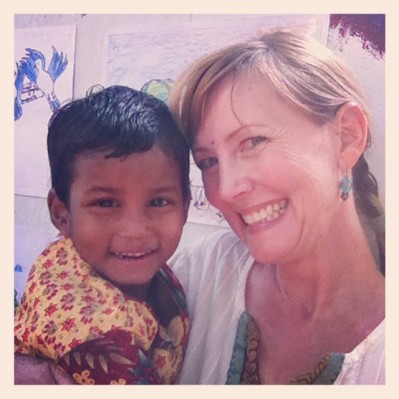
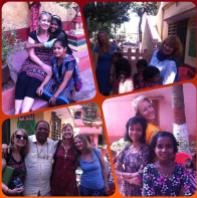

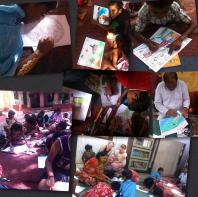
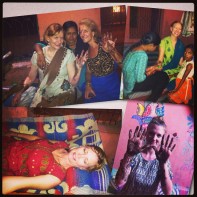
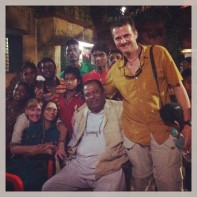
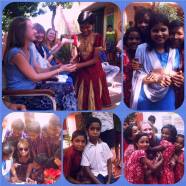
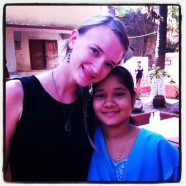
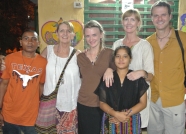
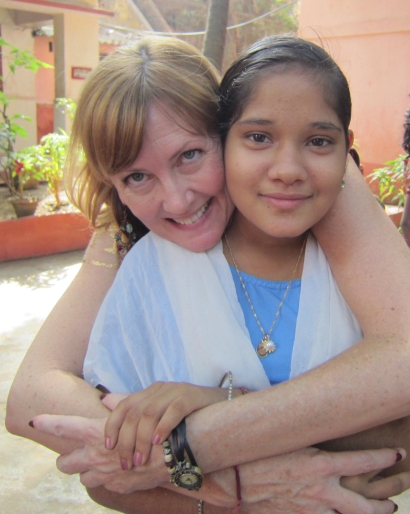
One of the best things about this trip, as well, was the incredible support we had from friends. Caroline Boudreaux, founder of The Miracle Foundation and the person who first introduced me to India and these children, led the charge with a generous personal donation and challenging others to do the same. We had 35 donors all told, including ourselves, and raised right at $6,000 to donate to buy much-needed supplies for the home! We were able to do some electrical upgrading, purchase school supplies and bedding, give some additional cash for items needed for the children, and put half of the money into a fund for education and future needs. THANK YOU to everyone who donated and supported this cause — you awe me, every one of you.
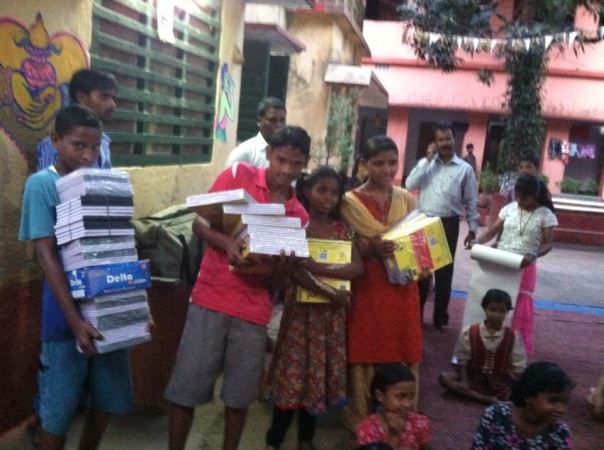
Bringing in the new school supplies!
The days were filled with laughter and love: dancing, singing, ice cream parties, games, beautification in the girls’ dorm rooms, drawing competitions, eating, and lots and lots of hugs.
I will post some more blog updates about specific things in the coming weeks. Until then, thank you all again for sharing our love for these kids, and making their lives so much better. You don’t even know what it means for them to feel special, loved and never forgotten. I will close with a short video of their welcome song. Namaste.


 The Weight of Silence